• Skip to main content
  • Skip to primary sidebar

PHYTOEXTRACTUM

The original banner for Phytoextractum
  • Home
  • Log In
  • Buy Kratom
    • Kratom Powder
    • Kratom Extract
    • Kratom Capsules
    • Kratom Shots
  • FAQ
  • Free Shipping!
  • About Us
  • Discount Codes
  • Free Stuff
  • Resources

Kratom

Kratom Update: Removed From “Narcotics List” In Thailand

January 28, 2020 by Phyto

It’s both very cool and very scary that the laws about kratom in this country and around the world are changing rapidly. On the one hand, bans are being enacted in some areas where negative propaganda has outweighed kratom support. On the other hand, positive changes are also happening almost every day.

In late December, representatives of Thailand’s government made it known that kratom will be formally removed from the narcotics list in Thailand in the near future.

If you know anything about where kratom comes from or the history of kratom laws in Thailand, you know that’s a pretty big deal. Let’s talk about why this matters, what exactly is changing, and how we can expect those changes to effect kratom use in the USA.

The Big Changes

A few major things have happened in Thailand:

  1. 1. Thailand’s National Legislative Assembly has voted (166 – 0) to legalize medical marijuana.
  2. 2. They also agreed to change the way that the National Narcotics Control Committee is set up.
  3. 3. Thailand’s Health and Justice Ministers wrote a memorandum advocating for the removal of both kratom and cannabis from the National Narcotics List and set them up for medical usage.

Each of these three changes has to go through the government before they are fully enacted, but change is on the horizon.

Let’s talk about each of these changes briefly, and then we’ll go into more detail about the kratom changes.

#1: Legalize Medical Marijuana

Medical marijuana was passed through the National Assembly with overwhelming support. It will take some time for the logistics of how medical marijuana will be managed, so it is not expected for this law to change on paper for a few more months.

In Thailand, laws are not usually considered active until they are published in the national gazette.

At this time, it is also not clear if the current punishments for possession or use of marijuana outside of medical usage. Currently, the punishment in Thailand for this type of possession is very severe, so it will be interesting to see if that changes.

#2: Narcotics Control Committee

The Narcotics Control Committee is the organization in Thailand that controls the punishments, laws, and scheduled narcotics list in Thailand. This organization has faced some scrutinization over time, so the structure of it will be changing.

#3: Memorandum For Kratom Removal

Thailand’s government has started the process of removing kratom and marijuana from the national narcotics list. The memorandum states that these substances should be moved into a controlled and regulated industry as they will have a lot of benefits for Thai people as well as the economy.

Now that the memorandum is in action, the next step will be for the National Legislative Assembly to vote on this change. The minister has suggested that the bill will be voted on by that group in March. If it passes, it will take a few more months for it to go into effect.

 When it is passed, companies will be able to start researching kratom, those with medical permission will be able to take kratom, and doctors will be able to use it to help patients as well.

Medical Changes First

It’s important to point out that these changes are aimed at only medical uses for both marijuana and kratom at this time. It is not expected for Thailand to completely legalize the use of either substance any time soon.

Think about the process that has been going on in the United States to legalize cannabis. First, limited medical usage was approved. Then, that usage was expanded in some states to be for recreational use as well. Now, it seems that the entire country is on the path for full legalization.

Should Thailand decide to fully decriminalize and legalize either of these substances, the process will likely go through a similar, gradual transition.

Thailand’s government has not yet set up the process for medical usage of either substance. However, some hospitals are already able to provide them for patient use.

A Changing Worldview

In the past, substances like marijuana and kratom were placed on the narcotics list for a variety of reasons. Still, the main reason was heavy opioid usage and the desire to cut down on any potential drug problems in the country.

These days, more research has been done about substances such as marijuana and kratom. The Thai government believes the research suggests beneficial effects. The government is seeing that changing the laws might be appropriate to reflect the science.

Another huge factor that is moving this idea along in Thailand is the idea that it could be great for the economy. Kratom production is severely regulated around the world, and the supply stream is dwindling. In Indonesia, for example, all kratom farms are being required to close in the next five years.

If Thailand were to start producing kratom and allow its sale internationally, it could secure a large boost for its economy. While nothing has yet been decided about whether or not kratom farming and processing will be permitted, it’s likely something that the government will consider.

Will This Affect Kratom In The US?

Most people that are using kratom and living in the US are going to be most curious about how these changes might affect them.

Ultimately, there are a few different ways that these changes could affect us here in the states. At this point, all of this is speculation, so keep that in mind. It will take a few months to know if any direct or waterfall effects occur here after these laws are made official.

First, it is possible that this change in Thailand’s laws will make it even more difficult for the FDA to push through an outright ban on kratom. Currently, the FDA often cites the fact that kratom is considered a narcotic in Thailand, where it grows wild. Once kratom is treated differently in Thailand, kratom might stand a better chance here, too.

Second, the change in laws about kratom in Thailand may make it easier for researchers to access and study kratom as it grows in the wild as well as in controlled settings.

Frequently, kratom is written off because people don’t believe that enough research about it has been done. While the research done about kratom is actually fairly extensive, more research is always beneficial when trying to prove the safety and usefulness of a botanical like kratom.

Filed Under: Kratom Tagged With: advocacy, advocate, ban, export, kratom, legalization, mitragyna speciosa, policy reform, regulation, research, schedule, thailand

State-by-State: Kratom Consumer Protection 2020 Predictions

January 7, 2020 by Phyto

2019 was a year of many changes in the way that kratom is classified, treated, and regulated in America. Through the efforts of advocacy agencies like the American Kratom Association and their supporters, four states passed Kratom Consumer Protection Acts, which protect consumers in those regions.

In 2020, they want to do even more.

By the end of the year, the American Kratom Association hopes to have protection acts passed in 25 states, meaning that 21 states would need to pass acts this year to accomplish the goal.

Is it possible? What states are being targeted? Find out all of this, and more, in today’s looks at what AKA will be focusing on for the coming year.

What Is The KCPA?

The kratom industry does not have a lot of regulation, control, or guidelines. Most industries have a set of good manufacturing practices that all reliable vendors and producers follow. The kratom industry did not have any such practices until recently.

Now, the American Kratom Association, AKA, runs the Good Compliance Standards Program. This voluntary program helps to ensure that:

  • vendors are properly testing their products
  • labeling their items
  • ensuring that their products are as safe and high-quality as possible

With the KCPA, the American Kratom Association hopes to continue beyond that voluntary program to set up some official, state-backed guidelines.

The Kratom Consumer Protection Act is a sample set of guidelines and rules that were created as an example for state governments. Each state that AKA works with can adapt these guidelines to suit their state, but the general outline of what it should include is as follows:

  • Defines kratom
  • Registers products and vendors operating in the state
  • Restricts and requires specific labeling practices
  • Requires testing to reduce adulterated or contaminated product presence
  • Sets up a state regulatory system

There are many different things that could be added to this as well. Ultimately, it is up to the legislators and lawmakers in each state to determine what they believe will be most effective in their state.

Amount & Synthetic Restrictions

Ideally, the KCPA legislation will also touch on the amount and types of alkaloids that can be in a kratom product.

As you might know, kratom’s benefits come from the alkaloids found in the plant. Alkaloids can, however, be created synthetically.

The KCPA suggests banning synthetic alkaloids and also putting a limit on the total amount of 7-OH that can be in the product. 7-OH, aka 7-hydroxymitragynine, is a metabolite of the primary alkaloids found in kratom.

States Where KCPA Exists

The AKA has already been working with states to implement the KCPA for some time now. Through their efforts, some form of this protection act exists in:

  • Nevada
  • Utah
  • Arizona
  • Georgia

Each of these states created their own version of the act, but the major components that will help to ensure that Americans can find safe, properly vetted kratom sources are underway in those areas.

States Where Kratom is Banned

Despite the best efforts of kratom advocacy groups, there are a few states where kratom bans have been passed.

Kratom is currently banned in these states:

  • Indiana
  • Vermont
  • Wisconsin
  • Alabama
  • Arkansas
  • Rhode Island

Though these outright bans are very real, AKA is planning to target four of these states during the 2020 goal stretch to reach 25 states with KCPA laws. The advocacy group believes that the bans in these areas are, at best, shaky with a lot of dissension. With some effort, the bans can be reversed.

Unfortunately, both Wisconsin and Arkansas do not have legislative sessions this year, but AKA plans to work with legislators and get things ready to be implemented in early 2021, if possible.

In Rhode Island, AKA has already had the opportunity to meet with a number of officials and scientists, so the process of attempting to overturn the kratom ban is already underway.

2020 Target States

These are the states that AKA will be targeting in 2020:

  • Tennessee
  • Mississippi
  • Florida
  • South Carolina
  • North Carolina
  • Virginia
  • West Virginia
  • Ohio
  • Pennsylvania
  • Oregon
  • Idaho
  • New York
  • Rhode Island
  • Wisconsin
  • Colorado
  • Kansas
  • Oklahoma
  • Missouri
  • Louisiana
  • Illinois
  • Michigan
  • Alabama
  • Arkansas

These states are the states where the AKA has already been working to lay the groundwork for the Kratom Consumer Protection Act to be implemented. The organization also took into account the amount of funding that they currently have available to put into the project.

The situation for all of these states is different, so AKA is handling a lot of moving parts. In some states, lobbyists are already working hard. In other states, funding and lobbyist efforts are needed to move forward with the goal.

Ultimately, it’s hard to say for certain if this goal will be completely achievable or not. When it comes to politics, a number of other issues could stand in the way and prevent a law from being passed until next year, but we firmly believe that a lot of progress in a positive direction will be made.

Want To Get Involved?

If you have any interest in getting involved in the advocacy efforts at your state or local level, you can do that! Ask around at your local kratom shop if there are any such groups working in the area or contact the AKA to find out where you could step in to lend a helping hand.

If you aren’t ready to get involved in a group but still want to support the efforts that are being made, you can do a few simple things:

  • Share your kratom stories on AKA’s website
  • Buy from vendors that support the GMP compliance program run by AKA
  • Send an email to your local or state officials letting them know of your opinion on any kratom-related legislation proposals

If we are to succeed in passing KCPA in all of these states in 2020, help is going to be necessary! Share your story; share your passion. With your help, the kratom industry can become safer than ever before.

Filed Under: Kratom Tagged With: accreditation, advocacy, AKA, american kratom association, citizenship, consumer protections, GMP, Good Manufacturing Practices, KCPA, Kratom Consumer Protection Act, kratom regulation, lab testing, legislation, lobbying, quality assurance, state laws

Kratom’s Evolving Legal Status

December 17, 2019 by Phyto

Please note: The information provided in this post does not, and is not intended to, constitute legal advice; rather, all information and content referenced in this post are for general informational purposes only.  This post may not contain the most up-to-date legal or other information. We encourage you to do your own thorough research to verify information and to check your local laws and regulations if you have questions about kratom’s legality in your area.

Local, federal, and international laws pertaining to kratom are constantly evolving. Here in the United States, the Food and Drug Administration (FDA) has put forth a great deal of misinformation in an effort to ban the plant, while organizations like the American Kratom Association (AKA), along with consumers, scientists, and other advocates work hard to ensure safe and legal access to this important botanical.

Laws change regularly, but we’ve gathered the most recent information about kratom’s legal status so you can educate yourself and advocate for kratom.


Is Kratom Legal Where I Live?

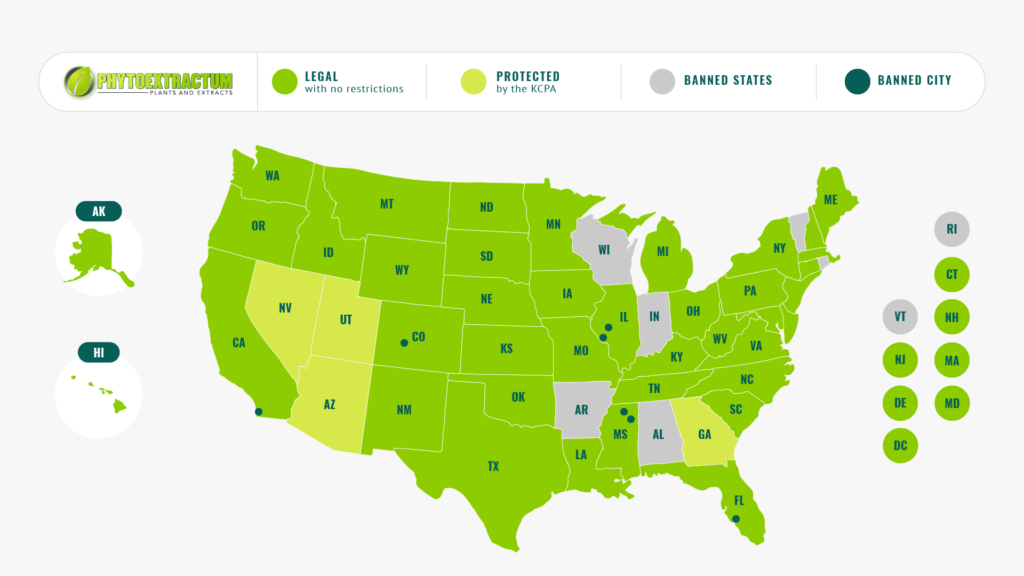
As of 2020, six states have banned kratom by listing it as a controlled substance. Kratom cannot be consumed, sold, or grown in these states. A few localities – cities and counties – have also made kratom illegal. Because new laws are enacted each year, it’s helpful to use the AKA’s resources to keep track of kratom’s legal status in your state.

Please refer to the below map for a quick visual guide to where Kratom is legal in the United States.

States Where Kratom Is Banned:

  • Alabama
  • Arkansas
  • Indiana
  • Rhode Island
  • Vermont
  • Wisconsin

Localities Where Kratom Is Banned:

Jerseyville, Illinois; San Diego, California; Sarasota County, Florida; Union County, Mississippi; Denver, Colorado (not illegal, but “not for human consumption”)

States with the Kratom Consumer Protection Act (KCPA):

Arizona, Georgia, Nevada, Utah

States with Age Restrictions:

New Hampshire: 18 and older; Tennessee: 21 and older; all states with KCPA

The American Kratom Association is currently working in over a dozen states to further enact the KCPA. This legislation would ensure both consumer safety and the legality of the kratom industry in states where it passes. Phyto wholeheartedly supports these efforts and is proud to work with the AKA to keep kratom legal.

Kratom Around the World: Is It Legal in My Country?

It is sometimes difficult to figure out kratom’s legal status in other countries because laws change on a regular basis. We try to stay current on international law, but we do not ship kratom internationally because of uncertainty around its status in some areas.

It’s always a good idea to do your own research before traveling abroad; look into local laws where you’re going, or check Reddit for answers to your international kratom questions.

Africa:
It’s not easy to find information about kratom’s legal status in Africa. We have learned that it is legal in South Africa but not widely used or even known.

Americas:
Canada’s laws are similar to Denver’s (above), where kratom is “not for human consumption.” You may find kratom described as plant matter, incense, or other vague terms. Kratom is legal in North and Central Latin America, as well as in South America. It’s not illegal in these places, but it’s also not very popular or easy to find.

Asia:
Kratom is banned in Israel, Japan, Myanmar, Malaysia, Singapore, South Korea, and Vietnam. It is legal in Hong Kong, but information kratom in China is limited.

In Thailand, kratom had been illegal since 1943, but this has recently changed. This month, the Thai government removed both kratom and cannabis from the country’s list of controlled substances, stating that these botanicals did not meet the World Health Organization’s criteria for narcotics.

Indonesia, where much of the kratom in the west is grown, is currently considering a ban on kratom exports. The American Kratom Association is working to educate the Indonesian government in an effort to impact this potential ban.

Europe:
Kratom is illegal across the board in Denmark, Finland, Latvia, Lithuania, Poland, Romania, Russia and Sweden. Due to changing laws, you should check local legislation for information about Ireland, Italy, and United Kingdom.

Oceania: Australia & New Zealand
Kratom is completely banned in Australia. It is a Schedule 1 substance in New Zealand, so it’s basically illegal. In some localities it may be prescribed by a doctor.

Buy Kratom online at Phytoextractum

How You Can Help

We’ve seen some exciting developments internationally, and we are eager to continue the kratom conversation on a world-wide scale. While there is some concern that Indonesia may implement a ban on kratom exports, there’s also great news in Thailand removing kratom from its list of banned substances.

Here in the US, we should always be ready to educate and advocate for kratom, especially as legislative sessions get going in early 2020. AKA has a solid plan in place to keep kratom legal on both the state and federal levels, and we support their work as much as possible.

Visit the AKA’s website to learn more about how you can get involved with advocacy efforts for our favorite botanical!

Filed Under: Kratom Tagged With: advocacy, AKA, alkaloids, american kratom association, ban, international, kratom, Kratom Consumer Protection Act, legality, legislation, mitragyna speciosa, states

Kratom for the Holidays: Great Gifts For Kratom Lovers

December 10, 2019 by Phyto

Every year, planning out what you are going to buy for your friends and family can be very stressful. It can even be stressful to be asked what you want for Christmas because you then need to come up with a list for yourself, too!

Here at Phytoextractum, we want to help make the holidays a little bit easier this year. If you like kratom and want to ask for some kratom-related gifts or perhaps you have a few friends that use kratom, we are here to help.

Our complete list today is going to be focused on kratom gift ideas for the winter holidays or any time! Hopefully, we’ll help you find the inspiration that you’ve been searching for.

1: Kitchen Scale

The first item that you might want to consider getting for a friend that loves kratom is a digital kitchen scale. Having a scale on hand is a great way to ensure that every serving of kratom is the same and accurate. When consistency is key, a scale is a necessity.

Plus, a kitchen scale can be used for more than just kratom! While it is incredibly useful for measuring out servings, it can also be useful for baking, portioning meals, and much more. You can even use a kitchen scale to help figure out postage for any packages or letters that you need to mail out.

A lot of people won’t want to invest in a kitchen scale for themselves, so buying one for a friend that is interested in kratom is a great way to treat them to something super special!

2: Capsule Prepping Kit

If you know a bit more about how your friend takes their kratom, you might be able to get them a specialized kit to help with their kratom consumption. Many people use kratom in capsule form, but buying pre-made capsules is usually much more expensive than it is to make your own capsules. 

To help your friend save a bit of money and take control of their specific servings, you can set them up with a capsule prepping kit. Try including the following items:

  • • Empty capsules
  • • Various strains of kratom
  • • Scale
  • • Capsule filler

With these tools, your friend will be able to easily and efficiently fill up their own capsules. Some people might already do this, but few will have the full capsule making tool that makes it quick and easy. Gifting this to your friend gifts them a lot of convenience.

Buy Kratom online at Phytoextractum
 

3: Flavor Set

Does your friend make their own kratom tea? Do they mix kratom liquids or tea concentrates into other beverages? If so, you might want to consider gifting them a kit of various things to make these drinks taste better!

It’s no secret that kratom tea isn’t the best-tasting thing out there. In fact, it can be pretty hard to get down for some. Finding ways to flavor tea is key, so why not put together a basket of fun flavors that they can use on their next concoction?

Try using some of the following items in your flavor gift basket to help them flavor their tea:

  • • Flavored syrups
  • • Honey
  • • Citrus fruit juices
  • • Specialty tea bags

All of these items are very easy to add to kratom tea to improve the flavor. Often, kratom users just get used to the rough taste, but they don’t need to if you can gift them something lovely to enjoy it with!

4: Tea Supplies

If you think that your friend prefers to keep things classic, you can still gift them some items to help with their kratom tea production. Making tea requires a number of tools to make sure you get a clean, filtered final product.

Consider purchasing any of the following items for your kratom-loving friend:

  • • Water filter
  • • Tea pot
  • • Tea bags of various sizes
  • • Mesh strainer
  • • Cheesecloth

One of the coolest things about gifting a friend some of these tea-making supplies is that they can use them to make other types of tea as well. It is, after all, possible to enjoy other types of tea besides kratom tea!

5: Apparel

This idea won’t work for everyone, but there are some people out there that just can’t get enough ball caps, themed hoodies, and customized T-shirts. Believe it or not, there are some organizations that sell kratom apparel. Any local shop that your friend likes to buy their kratom from might have some apparel, too!

This type of gift is best for the type of friend that enjoys showing their public support for kratom. Not everyone feels confident enough to rock this type of apparel, and that’s okay. Consider your friend’s personality before you commit to this type of gift.

6: Donation

Does your friend support any Kratom-focused nonprofits, such as the American Kratom Association? Are they concerned about the risk of kratom becoming an illegal substance in the US? If so, you may want to consider gifting them something a little out of the box: a donation!

By donating to kratom research and support organizations in your friend’s name, you’ll be helping them support the future of a botanical they love to use. And that is a great gift for any occasion!

7: Storage System

If the friend that you are searching for a gift for is a prolific kratom user or a veteran user that loves to rotate which strain they are using, the chances are pretty high that they have a large shelf for all their kratom products.

Have you ever seen this shelf? Is it organized, or is it a complete mess? 

If your friend hasn’t quite figured out how to keep all their kratom stored yet, you might want to consider purchasing some storage containers for them. Kratom leaves and powder are best stored in dark, air-tight containers where heat, air, and sunlight cannot affect them.

We love dark-colored glass containers as the best Kratom storage type. Purchasing a few jars or containers like that for your friend will help them get organized!

Filed Under: Kratom Tagged With: 7-hydroxymitragynine, accessories, alkaloid, alkaloids, birthday, botanical, christmas, gifting, gifts, hanukkah, holidays, kratom, m. speciosa, mitragyna speciosa, mitragynine, tea, what is kratom, winter

5 Ways To Make Kratom Tea Taste Better Than Ever Before

December 3, 2019 by Phyto

Those of us that use kratom regularly may be able to agree that it has big benefits, but that isn’t the only thing that we can agree upon. Most of us will also agree that kratom tea simply doesn’t taste that great! Sure, you can get it down, but who wants to drink something regularly that just isn’t good?

While you could think of this problem as a simple fact of using kratom, we like to be more creative about things around here at Phytoextractum. As a sort of inspiration, we’re gearing up today to share with your our top five methods for making kratom tea taste better than ever before.

If you have any other great suggestions for how to improve the tea’s flavor, be sure to let us know!

Making Kratom Tea

While it’s important to learn how to flavor your kratom tea in new and interesting ways, it is also important for you to learn how to make kratom tea the right way! Kratom tea needs to taste as good as possible when you get started so that there is a chance to make it taste even better.

This is a bare-bones guide on how to make some great kratom tea:

  1. 1. Start with a liter of water.
  2. 2. Bring the water to a full boil in the pot.
  3. 3. Lower the heat, and let the water come off of the boil for at least three minutes.
  4. 4. Put the kratom powder or leaves in a mesh strainer.
  5. 5. Add to the water.
  6. 6. Let the kratom simmer in the water for about 20 minutes.
  7. 7. Remove the mesh strainer or use the cheesecloth to get the powder out of the leftover kratom tea.

Once finished, kratom tea can be consumed hot, cold, or even after it has been refrigerated for up to five days. This means that you can make a bigger batch of kratom once or twice a week so that you don’t have to make it every single time you want to drink your kratom tea.

Buy Kratom online at Phytoextractum
 

How To Make Kratom Tea Taste Better

Now that you know all of the basics of how to make kratom tea, it is time to learn how to make kratom tea taste better! There are a lot of different solutions that you can use, but these are the five different ways that we prefer to improve the flavor of our kratom tea.

Add Flavored Tea Bags

When you’re brewing kratom tea, taking a minute to brew up another flavor of tea as well can be the key to making your kratom tea taste better! Combining the earthiness of kratom tea with a sweet, fruity tea can make it taste incredible. You can even mix up multiple different kinds of tea in the batch so that you can have your own special concoction.

There are many flavors of tea that go well with the taste of kratom:

  • • Green tea
  • • Citrus tea
  • • Raspberry tea
  • • Vanilla tea
  • • Chai tea
  • • Any fruit tea
  • • Sweet tea
  • • Spice teas
  • • Tea lemonades
  • • … and much more!

The possibilities are as limitless as your tea cabinet, so get creative and try out different combinations to figure out what will taste the best. Once you choose a tea, choose twice as many tea bags as you usually use and then brew it up. This will help to make a concentrated enough flavor to compete with the flavor of the kratom tea.

Mix With Milk

When many people drink coffee or a traditional tea, they like to add milk and sweetener to it so that it fits with their favorite taste profiles. For kratom tea, you can do the same thing!

Many sweetened milk products, such as vanilla creamer, can be added to kratom tea to help cut into the bitterness and add a bit of sweetness to the final drink. Adding milk makes everything taste just a little bit better than the usual earthiness that kratom tea offers.

There are many types of milk that you can add to kratom tea to try to balance out the flavor:

  • • Dairy creamers (they come in lots of flavors!)
  • • Soy milk (flavored or plain, but we prefer vanilla)
  • • Oat milk (vanilla is best)
  • • Straight milk (not as flavored, but good for those who don’t want to add more sugar)

Many kratom lovers have found that using almond milk as an easy addition to kratom tea. Not only is it delicious, but it also has a lot of alkaloids which makes it work well with the standard chemical composition of kratom tea.

Mix With Citrus

Adding citrus to kratom tea is a great way to cut through the earthy flavor of kratom. Many find the richness to be way too heavy to easily drink, so cutting through that is a key part of improving the flavor of kratom.

In particular, we love to add honey, sugar, and lemon to kratom tea in order to make it more palatable. Of course, those aren’t the only things that you can add to tea to make it better.

We love adding lemon for a few reasons:

  • • Citric acid helps to balance out alkaline content to help it be more efficient.
  • • Citric acid also helps to keep kratom tea stored in your refrigerator last for even longer.

If you aren’t a big fan of lemons, you could also use other fruits like orange or grapefruit instead. If you want to mix kratom powder into a full glass of citrus juice, you can do that as well. There are a lot of different ways to incorporate citrus flavor into your tea, so experiment a little bit.

Add Flavored Syrups

Have you ever gotten a flavored coffee or latte before? To make the latte taste that way, flavored syrups are used. These syrups come in lots of different flavors such as sweet and fruity flavors. Those flavors, in particular, can help to make kratom tea taste much better.

Sweeten Everything

This is a simple solution, but it is one that works for some people! Adding honey, sugar, or another sweetener to your kratom tea will immediately help to cut through the rich, dark flavor of the kratom. We recommend starting with one teaspoon of your favorite sweetener for each mug of kratom tea, but you can add more until the balance is just right.

Filed Under: Kratom Tagged With: 7-hydroxymitragynine, alkaloid, alkaloids, botanical, brewing, hot beverages, kratom, m. speciosa, mitragyna speciosa, mitragynine, tasty, tea, what is kratom, yummy

Kratom Products Labels: What They Mean And Why They Matter

November 19, 2019 by Phyto

Have you ever taken the time to read the product label on the last batch of kratom that you bought? Do you know what type of information you should see on that type of label? Or are you completely unsure about what it says on the package other than the company and product name?

If you’ve ever taken the time to look at a kratom label, the chances are pretty high that you haven’t found much information there. Due to a lack of regulation in the industry, there isn’t a lot of incentive for companies to include a lot of information.

Here at Phytoextractum, we find that to be incredibly frustrating. What is a consumer supposed to do if they can’t get any information from the label? Are people expected to know everything about a product before they buy it?

Let’s take a look at the complicated world of kratom product labels and what we hope to see happen in the future.

Creating a Brand

The first reason that we’re used to seeing labels on products is to let you know who made it. Brands are eager to put their names and logos on everything that they put into the world because they know that indirect marketing like this can bring them more business in the long run.

Consumers who have used their products before are more likely to recognize their name and logo if they saw it on the packaging, and that recognition can lead them to buy again. That’s why companies put so much time and money into choosing the right imagery, colors, and words for their logos.

Branding is incredibly important in all industries, and the kratom industry is no exception.

Buy Kratom online at Phytoextractum
 

Generalized Label Expectations

At this time, not all states require specific information to be included on kratom labels. We believe that this doesn’t mean that general label expectations should not be followed. In fact, we think that the lack of regulation makes it even more important.

Usage

The first thing that needs to be included is some type of instructions about how to use the product. Any relevant information and suggestions from the manufacturer to the consumer can be included here so that the customer sees it.

Warnings

Other things that you can (and should) see on a label are warnings. If there are any cautions, warnings, or other precautionary information that would benefit the consumer to know, it is a company’s obligation to warn the customer about these things.

Many products have warnings that are regulated and must be put on every product, such as cigarettes. For unregulated products such as kratom, however, no such requirements exist.

Stats

Another important thing to include on the label is any specific information about what is in the product. Ingredients, nutritional information, serving size, and more are all examples of stats that you might find on a product label.

As kratom is not under FDA regulation, product labels should not include any type of nutritional information unless otherwise advised by a regulatory agency.

The Complicated Kratom Label Situation

If you know anything about kratom’s legal status, you know that the status is always at risk. While some states have legalized kratom and made moves to protect consumers from unregulated dangers, not every state is as open to the idea of legal kratom.

Because of this, there are no official regulations that kratom vendors need to follow when they sell their products. There are some things that vendors are not allowed to say per FDA rules, but that doesn’t mean they have to say other things instead.

Vendors can put whatever they want on the labels, and we don’t believe that is enough. Though official classification of kratom at levels is still underway, it is possible to label kratom properly.

AKA’s GMP Label Program

For own labeling purposes, we follow the labeling protocol that is outlined within the American Kratom Association’s GMP Standards Program. The AKA is working tirelessly to help protect kratom consumers in America, and we believe that this is a program fully worth supporting.

With the standards laid out through AKA’s research, we (and other kratom vendors) can be sure to protect our consumers to the best of our abilities.

Banner For Kratom Products
 

AKA’s Label Requirements

To be part of the GMP program with AKA, you have to follow their guidelines. Many of the guidelines have to do with labels, as you can see in the program guidelines:

  • • The labels, labeling, or advertising of any kratom product should not bear any disease claims (i.e., claims regarding the treatment, cure, prevention, or mitigation of disease) or unauthorized health claims.
  • • The labels, labeling, or advertising of any kratom product should not bear any structure/function claims.
  • • The labels, labeling, or advertising of any kratom product should not reference any research or clinical data.
  • • Each finished product label must include a batch or lot number.
  • • Each finished product should be labeled to disclose the mitragynine and 7-OH alkaloid content of the product.
  • • Each finished product label must advise consumers to consult with a physician for dosing information relative to alkaloid values.
  • • No kratom products may be sold to individuals under the age of 18.
  • • The label should bear a statement that pregnant women should not use kratom products during pregnancy.
  • • All labels, labeling, or advertising should include the following statement: “This product is not intended to diagnose, treat, cure, or prevent any disease or condition.”

As you can see, those labeling requirements can be quite complicated, but that’s not a problem because AKA resources to help clarify things for vendors and consumers alike. The requirements don’t exist just to be complicated. They exist to ensure that vendors and consumers both are protected from the risks and dangers of the industry.

When you’re buying kratom online or in stores, take the time to look at the label on each product. Does the label give you good information? Do you feel like you have a good idea of the product by the time you read through it? If you answered yes to those questions, you should feel confident that you’re making a good choice.

Filed Under: Kratom Tagged With: 7-hydroxymitragynine, AKA, alkaloid, alkaloids, botanical, branding, GMP, guidelines, kratom, labeling, labels, m. speciosa, mitragyna speciosa, mitragynine, what is kratom

  • « Go to Previous Page
  • Go to page 1
  • Interim pages omitted …
  • Go to page 6
  • Go to page 7
  • Go to page 8
  • Go to page 9
  • Go to page 10
  • Interim pages omitted …
  • Go to page 12
  • Go to Next Page »

Primary Sidebar

Latest Resources

  • Kratom Near Me? Why Online Beats Your Local Shop
  • Kratom Laws in 2026: Your State-by-State Guide
  • 20 Years of Trust: Phytoextractum’s Journey
  • HHS Bans 7OH: A Win for Safe, Natural Kratom
  • Last Chance: Louisiana Kratom Ban on 8/1

Resource Categories

  • CBD
  • Guide
  • Kava
  • Kratom
  • Mushrooms

Search Resources

QUICK LINKS

    • Home
    • Discount Coupons
    • Bitcoin
    • FAQ
    • Affiliates


INFORMATION

    • About Us
    • Sitemap
    • Lab Testing
    • COD
    • Customer Rewards


CUSTOMER SERVICE

  • Contact Us
  • Shipping & Returns
  • Privacy Policy
  • Terms & condition
  • My Account
Bitcoin logo

© 2023 Phytoextractum - Resources. All Rights Reserved.