If you’ve been following our blog, you know that the kratom legal landscape has been shifting at an unprecedented pace. Between new bans, breakthrough protections, and a wave of pending bills, 2025 and early 2026 have been some of the most consequential months in kratom’s legislative history.
We built this guide as a single resource you can bookmark and come back to. Below you’ll find an interactive map, a searchable state table, a timeline of the biggest recent developments, and more. Whether you’re a long-time advocate or just getting up to speed, this is everything you need to know about kratom’s legal standing right now.
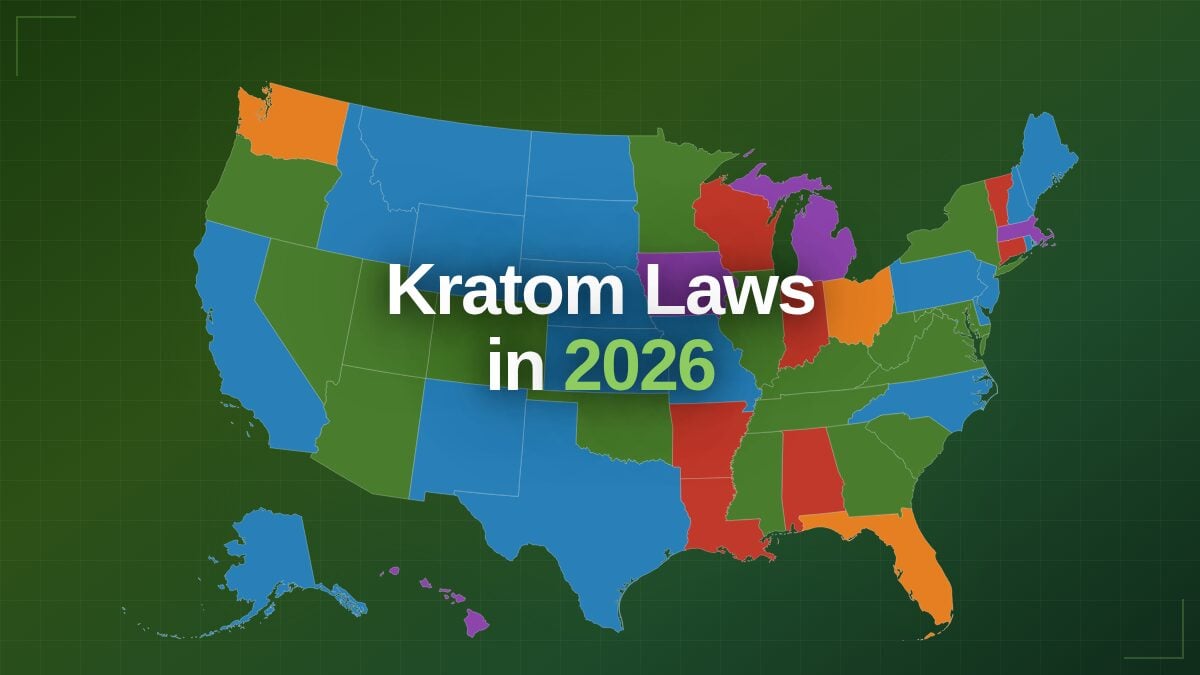
Interactive Legal Status Map
Click or hover over any state to see its current kratom legal status and recent developments. Use the filter buttons below the map to highlight specific categories.
What Changed in 2025–2026: A Timeline
Here’s a quick look at the most significant legislative developments over the past year. Green events represent wins for kratom access; red events represent new bans or restrictions; orange marks pending or mixed developments.
South Carolina’s KCPA went into effect, requiring retailers to keep kratom products in locked display cases and setting limits on synthetic alkaloid content — a model for responsible regulation.
In a disappointing development, Connecticut’s governor signed a bill that designated kratom and its derivatives — including 7-OH — as Schedule I substances. Enforcement began in February 2026.
In a historic first, Rhode Island passed legislation to reverse its kratom ban and transition to a regulated framework. The new rules take effect April 1, 2026 — making it the first state to reverse course on a kratom prohibition.
The HHS emergency scheduling recommendation placed synthetic 7-hydroxymitragynine firmly in Schedule I at the federal level. This targets synthetic derivatives — not natural kratom — but it has accelerated state-level action on 7-OH products.
Louisiana’s SB 154 went into effect, making it the 6th state to fully prohibit kratom. The law reclassified key kratom alkaloids as Schedule I substances with penalties up to 5 years imprisonment. Phytoextractum can no longer ship to Louisiana addresses.
Ohio’s Board of Pharmacy issued an emergency rule banning most kratom products except those composed solely of pure mitragynine. The 180-day window for permanent rulemaking is underway.
The city of Spokane, Washington enacted a local ban on kratom sales — a reminder that even in legal states, local jurisdictions can impose their own restrictions.
Governor Lee signed HB1649 (“Matthew Davenport’s Law”), making Tennessee the 8th state to fully prohibit kratom. The law bans all kratom products — natural leaf and 7-OH alike — effective July 1, 2026. Possession becomes a Class A misdemeanor and sale a Class C felony. Phytoextractum will no longer be able to ship to Tennessee addresses once the ban takes effect.
Full State-by-State Reference Table
Search for your state below. This table includes every state’s current status, age requirements (where applicable), and notes on recent or pending changes.
By the Numbers: 2026 Snapshot
What’s Happening with 7-OH?
One of the biggest developments in 2025 was the wave of action around 7-hydroxymitragynine (7-OH), a concentrated kratom derivative. Here’s the key context:
At Phytoextractum, we have never sold or supported synthetic 7-OH products. We believe the distinction between natural kratom and synthetic derivatives is critically important, and we support sensible regulation that protects consumers while preserving access to natural, lab-tested kratom.
States that have independently restricted or banned 7-OH products include: Louisiana, Connecticut, Mississippi, Colorado, Florida, Ohio, Tennessee, and South Carolina — though in many of these states, natural kratom remains fully legal and accessible.
Why Advocacy Matters More Than Ever
If the timeline above makes one thing clear, it’s that nothing is settled. States are moving in both directions — some passing protections (Mississippi, South Carolina, Rhode Island) while others advance new bans (Connecticut, Tennessee, Michigan). The outcome often depends on whether informed voices show up to the conversation.
Here’s what you can do:
State legislators vote on kratom bills. A personal call or email from a constituent makes a real difference — especially when bills are in committee.
The Kratom Consumer Protection Act creates a responsible framework: age restrictions, lab testing requirements, and labeling standards. It’s the opposite of an unregulated free-for-all.
The American Kratom Association coordinates advocacy efforts nationwide. They track bills, mobilize supporters, and provide resources for testimony and public comment.
We’ll Keep This Updated
We plan to update this guide regularly as new legislation passes, existing bills advance, and the legal landscape continues to evolve. Bookmark this page and check back so you never miss an update.
Have a question about kratom legality in your specific area? Drop us a note at info@phytoextractum.com and we’ll do our best to point you in the right direction.
As always, thank you for being part of the Phyto family. Your support — and your advocacy — makes all the difference.