
• Skip to main content
  • Skip to primary sidebar

PHYTOEXTRACTUM

The original banner for Phytoextractum
  • Home
  • Log In
  • Buy Kratom
    • Kratom Powder
    • Kratom Extract
    • Kratom Capsules
    • Kratom Shots
  • FAQ
  • Free Shipping!
  • About Us
  • Discount Codes
  • Free Stuff
  • Resources

legality

Kratom Laws in 2026: Your State-by-State Guide

March 4, 2026 by Phyto

If you’ve been following our blog, you know that the kratom legal landscape has been shifting at an unprecedented pace. Between new bans, breakthrough protections, and a wave of pending bills, 2025 and early 2026 have been some of the most consequential months in kratom’s legislative history.

We built this guide as a single resource you can bookmark and come back to. Below you’ll find an interactive map, a searchable state table, a timeline of the biggest recent developments, and more. Whether you’re a long-time advocate or just getting up to speed, this is everything you need to know about kratom’s legal standing right now.

⚠️ Important Disclaimer This guide is for informational purposes only and does not constitute legal advice. Laws change frequently — always verify your local and state regulations before making any purchasing decisions. If you have specific legal questions, please consult a qualified attorney in your state.

Interactive Legal Status Map

Click or hover over any state to see its current kratom legal status and recent developments. Use the filter buttons below the map to highlight specific categories.

Legal & Regulated (KCPA)
Legal (No Specific Law)
Restricted / Partial
Banned
Pending Major Legislation

What Changed in 2025–2026: A Timeline

Here’s a quick look at the most significant legislative developments over the past year. Green events represent wins for kratom access; red events represent new bans or restrictions; orange marks pending or mixed developments.

May 2025
South Carolina Signs KCPA Into Law

South Carolina’s KCPA went into effect, requiring retailers to keep kratom products in locked display cases and setting limits on synthetic alkaloid content — a model for responsible regulation.

June 2025
Connecticut Governor Signs HB6855

In a disappointing development, Connecticut’s governor signed a bill that designated kratom and its derivatives — including 7-OH — as Schedule I substances. Enforcement began in February 2026.

July 2025
Rhode Island Reverses Its Ban 🎉

In a historic first, Rhode Island passed legislation to reverse its kratom ban and transition to a regulated framework. The new rules take effect April 1, 2026 — making it the first state to reverse course on a kratom prohibition.

July 2025
HHS Recommends 7-OH Scheduling

The HHS emergency scheduling recommendation placed synthetic 7-hydroxymitragynine firmly in Schedule I at the federal level. This targets synthetic derivatives — not natural kratom — but it has accelerated state-level action on 7-OH products.

August 2025
Louisiana Ban Takes Effect

Louisiana’s SB 154 went into effect, making it the 6th state to fully prohibit kratom. The law reclassified key kratom alkaloids as Schedule I substances with penalties up to 5 years imprisonment. Phytoextractum can no longer ship to Louisiana addresses.

December 2025
Ohio Issues Emergency Kratom Rule

Ohio’s Board of Pharmacy issued an emergency rule banning most kratom products except those composed solely of pure mitragynine. The 180-day window for permanent rulemaking is underway.

March 2026
Spokane, WA Enacts City-Level Ban

The city of Spokane, Washington enacted a local ban on kratom sales — a reminder that even in legal states, local jurisdictions can impose their own restrictions.

April 2026
Tennessee Signs Full Kratom Ban

Governor Lee signed HB1649 (“Matthew Davenport’s Law”), making Tennessee the 8th state to fully prohibit kratom. The law bans all kratom products — natural leaf and 7-OH alike — effective July 1, 2026. Possession becomes a Class A misdemeanor and sale a Class C felony. Phytoextractum will no longer be able to ship to Tennessee addresses once the ban takes effect.

Full State-by-State Reference Table

Search for your state below. This table includes every state’s current status, age requirements (where applicable), and notes on recent or pending changes.

AlabamaBanned
Banned since 2016. Alkaloids classified Schedule I.
AlaskaLegal
No statewide law. Proposed Anchorage ban pending.
ArizonaRegulated
KCPA in effect.
Age: 18+
ArkansasBanned
Full statewide prohibition.
CaliforniaLegal
No specific kratom regulation.
ColoradoRegulated
KCPA. Denver has local ban. Synthetic 7-OH banned.
Age: 18+
ConnecticutBanned
NEW: Schedule I designation (HB6855). Effective Feb 2026.
DelawareLegal
No restrictions.
FloridaRestricted
Legal except Sarasota County ban. 7-OH products restricted.
GeorgiaRegulated
KCPA. Age raised to 21+ in Jan 2025.
Age: 21+
HawaiiPending
Currently legal. Ban legislation under consideration.
IdahoLegal
Legal. KCPA bill (SB 1282) stalled in committee.
IllinoisRegulated
KCPA in effect.
Age: 18+
IndianaBanned
Banned since 2014.
IowaPending
Currently legal. SF 2013 proposes Schedule I classification.
Age: 18+
KansasLegal
Minimal restrictions.
KentuckyRegulated
Legal with KCPA-style regulation.
LouisianaBanned
NEW BAN Aug 2025 (SB 154). Up to 5 years imprisonment.
MaineLegal
No statewide restrictions.
MarylandRegulated
KCPA passed and signed 2024.
MassachusettsPending
Currently legal. Competing KCPA & ban bills filed 2025.
MichiganPending
Currently legal. HB 5537 would prohibit kratom.
MinnesotaRegulated
Legal 18+. Pending KCPA review.
Age: 18+
MississippiRegulated
KCPA (HB1077) effective Jul 2025. Bans synthetic 7-OH.
Age: 21+
MissouriLegal
Legal. Regulations under review.
MontanaLegal
No specific regulation.
NebraskaLegal
No specific regulation.
NevadaRegulated
KCPA passed.
New HampshireLegal
Legal 18+. Some local variations.
Age: 18+
New JerseyLegal
No specific kratom regulation.
New MexicoLegal
No specific regulation.
New YorkRegulated
21+ sales restriction implemented 2025.
Age: 21+
North CarolinaLegal
Legal. 18+ age practice widely followed.
Age: 18+
North DakotaLegal
No specific regulation.
OhioRestricted
Emergency rule Dec 2025: bans most products except pure mitragynine.
OklahomaRegulated
KCPA regulation established.
OregonRegulated
21+ age req. Kratom must be disclosed as ingredient.
Age: 21+
PennsylvaniaLegal
No specific kratom regulation.
Rhode IslandLegal
Ban REVERSED Jul 2025. Regulated framework effective Apr 1, 2026.
South CarolinaRegulated
KCPA signed May 2025. Locked display cases required.
South DakotaLegal
Legal 21+. Ban attempt failed Jan 2026.
Age: 21+
TennesseeBanned
Complete statewide ban effective 07/01/2026
TexasLegal
Legal. Pending regulation bills.
UtahRegulated
KCPA passed. SB 45 pending would repeal KCPA.
VermontBanned
Complete statewide ban.
VirginiaRegulated
KCPA passed 2023.
WashingtonRestricted
Legal except Spokane city ban (Mar 2026). 95% tax proposed.
West VirginiaRegulated
KCPA passed 2023.
WisconsinBanned
Statewide prohibition.
WyomingLegal
No specific regulation.

By the Numbers: 2026 Snapshot

16
States with KCPA or similar regulation
19
States legal with no specific law
8
States with full bans
3
States with partial restrictions
4+
States with major pending bills

What’s Happening with 7-OH?

One of the biggest developments in 2025 was the wave of action around 7-hydroxymitragynine (7-OH), a concentrated kratom derivative. Here’s the key context:

✅ Federal Status Kratom itself remains unscheduled and legal at the federal level as of March 2026. The HHS scheduling recommendation specifically targets synthetic 7-OH — not natural kratom leaf or traditional kratom products.

At Phytoextractum, we have never sold or supported synthetic 7-OH products. We believe the distinction between natural kratom and synthetic derivatives is critically important, and we support sensible regulation that protects consumers while preserving access to natural, lab-tested kratom.

States that have independently restricted or banned 7-OH products include: Louisiana, Connecticut, Mississippi, Colorado, Florida, Ohio, Tennessee, and South Carolina — though in many of these states, natural kratom remains fully legal and accessible.

Why Advocacy Matters More Than Ever

If the timeline above makes one thing clear, it’s that nothing is settled. States are moving in both directions — some passing protections (Mississippi, South Carolina, Rhode Island) while others advance new bans (Connecticut, Tennessee, Michigan). The outcome often depends on whether informed voices show up to the conversation.

Here’s what you can do:

💬 Contact Your Reps
State legislators vote on kratom bills. A personal call or email from a constituent makes a real difference — especially when bills are in committee.
📜 Support the KCPA
The Kratom Consumer Protection Act creates a responsible framework: age restrictions, lab testing requirements, and labeling standards. It’s the opposite of an unregulated free-for-all.
🤝 Join the AKA
The American Kratom Association coordinates advocacy efforts nationwide. They track bills, mobilize supporters, and provide resources for testimony and public comment.

We’ll Keep This Updated

We plan to update this guide regularly as new legislation passes, existing bills advance, and the legal landscape continues to evolve. Bookmark this page and check back so you never miss an update.

Have a question about kratom legality in your specific area? Drop us a note at info@phytoextractum.com and we’ll do our best to point you in the right direction.

As always, thank you for being part of the Phyto family. Your support — and your advocacy — makes all the difference.
⚠️ Reminder This article is updated periodically but may not reflect the very latest changes in every jurisdiction. Always check your state and local laws before making purchasing decisions. This is not legal advice.

Filed Under: Kratom Tagged With: advocacy, american kratom association, kratom, legality, legislation, regulation

Kratom’s Evolving Legal Status

December 17, 2019 by Phyto

Please note: The information provided in this post does not, and is not intended to, constitute legal advice; rather, all information and content referenced in this post are for general informational purposes only.  This post may not contain the most up-to-date legal or other information. We encourage you to do your own thorough research to verify information and to check your local laws and regulations if you have questions about kratom’s legality in your area.

Local, federal, and international laws pertaining to kratom are constantly evolving. Here in the United States, the Food and Drug Administration (FDA) has put forth a great deal of misinformation in an effort to ban the plant, while organizations like the American Kratom Association (AKA), along with consumers, scientists, and other advocates work hard to ensure safe and legal access to this important botanical.

Laws change regularly, but we’ve gathered the most recent information about kratom’s legal status so you can educate yourself and advocate for kratom.


Is Kratom Legal Where I Live?

As of 2020, six states have banned kratom by listing it as a controlled substance. Kratom cannot be consumed, sold, or grown in these states. A few localities – cities and counties – have also made kratom illegal. Because new laws are enacted each year, it’s helpful to use the AKA’s resources to keep track of kratom’s legal status in your state.

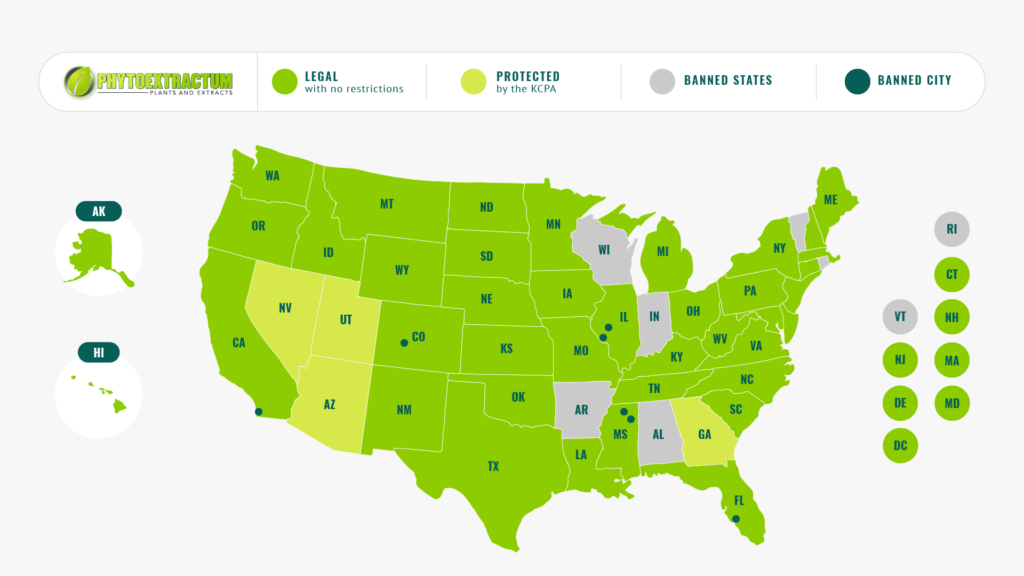
Please refer to the below map for a quick visual guide to where Kratom is legal in the United States.

States Where Kratom Is Banned:

  • Alabama
  • Arkansas
  • Indiana
  • Rhode Island
  • Vermont
  • Wisconsin

Localities Where Kratom Is Banned:

Jerseyville, Illinois; San Diego, California; Sarasota County, Florida; Union County, Mississippi; Denver, Colorado (not illegal, but “not for human consumption”)

States with the Kratom Consumer Protection Act (KCPA):

Arizona, Georgia, Nevada, Utah

States with Age Restrictions:

New Hampshire: 18 and older; Tennessee: 21 and older; all states with KCPA

The American Kratom Association is currently working in over a dozen states to further enact the KCPA. This legislation would ensure both consumer safety and the legality of the kratom industry in states where it passes. Phyto wholeheartedly supports these efforts and is proud to work with the AKA to keep kratom legal.

Kratom Around the World: Is It Legal in My Country?

It is sometimes difficult to figure out kratom’s legal status in other countries because laws change on a regular basis. We try to stay current on international law, but we do not ship kratom internationally because of uncertainty around its status in some areas.

It’s always a good idea to do your own research before traveling abroad; look into local laws where you’re going, or check Reddit for answers to your international kratom questions.

Africa:
It’s not easy to find information about kratom’s legal status in Africa. We have learned that it is legal in South Africa but not widely used or even known.

Americas:
Canada’s laws are similar to Denver’s (above), where kratom is “not for human consumption.” You may find kratom described as plant matter, incense, or other vague terms. Kratom is legal in North and Central Latin America, as well as in South America. It’s not illegal in these places, but it’s also not very popular or easy to find.

Asia:
Kratom is banned in Israel, Japan, Myanmar, Malaysia, Singapore, South Korea, and Vietnam. It is legal in Hong Kong, but information kratom in China is limited.

In Thailand, kratom had been illegal since 1943, but this has recently changed. This month, the Thai government removed both kratom and cannabis from the country’s list of controlled substances, stating that these botanicals did not meet the World Health Organization’s criteria for narcotics.

Indonesia, where much of the kratom in the west is grown, is currently considering a ban on kratom exports. The American Kratom Association is working to educate the Indonesian government in an effort to impact this potential ban.

Europe:
Kratom is illegal across the board in Denmark, Finland, Latvia, Lithuania, Poland, Romania, Russia and Sweden. Due to changing laws, you should check local legislation for information about Ireland, Italy, and United Kingdom.

Oceania: Australia & New Zealand
Kratom is completely banned in Australia. It is a Schedule 1 substance in New Zealand, so it’s basically illegal. In some localities it may be prescribed by a doctor.

Buy Kratom online at Phytoextractum

How You Can Help

We’ve seen some exciting developments internationally, and we are eager to continue the kratom conversation on a world-wide scale. While there is some concern that Indonesia may implement a ban on kratom exports, there’s also great news in Thailand removing kratom from its list of banned substances.

Here in the US, we should always be ready to educate and advocate for kratom, especially as legislative sessions get going in early 2020. AKA has a solid plan in place to keep kratom legal on both the state and federal levels, and we support their work as much as possible.

Visit the AKA’s website to learn more about how you can get involved with advocacy efforts for our favorite botanical!

Filed Under: Kratom Tagged With: advocacy, AKA, alkaloids, american kratom association, ban, international, kratom, Kratom Consumer Protection Act, legality, legislation, mitragyna speciosa, states

Primary Sidebar

Latest Resources

  • Kratom Near Me? Why Online Beats Your Local Shop
  • Kratom Laws in 2026: Your State-by-State Guide
  • 20 Years of Trust: Phytoextractum’s Journey
  • HHS Bans 7OH: A Win for Safe, Natural Kratom
  • Last Chance: Louisiana Kratom Ban on 8/1

Resource Categories

  • CBD
  • Guide
  • Kava
  • Kratom
  • Mushrooms

Search Resources

QUICK LINKS

    • Home
    • Discount Coupons
    • Bitcoin
    • FAQ
    • Affiliates


INFORMATION

    • About Us
    • Sitemap
    • Lab Testing
    • COD
    • Customer Rewards


CUSTOMER SERVICE

  • Contact Us
  • Shipping & Returns
  • Privacy Policy
  • Terms & condition
  • My Account
Bitcoin logo

© 2023 Phytoextractum - Resources. All Rights Reserved.